If you’re reading this, you’ve probably already been familiar with contact lenses or glasses (or both) for years and kIf you are reading this, you have most likely been wearing glasses or contact lenses for years (and sometimes both). You know what it can be like: limitations in sports, discomfort while traveling, dry eyes, fogged-up glasses, and the need to always carry solution, a case, and a spare pair. Sooner or later, a logical question arises: why does vision become blurry at all, and what exactly happens in the eye?
What is refraction, and why do vision problems occur?
When light passes from one medium to another (for example, from air into water), it changes direction—this is called refraction. In the eye, the “optical system” is formed by the cornea and the lens: they refract light rays so that they converge precisely on the retina. That is when an image becomes clear.
If, for certain reasons, light rays cannot focus on the retina, we speak of refractive errors. Most often, the cause is an individual eye shape (axial length of the eyeball, corneal curvature) or age-related changes in the lens.
Below is a short and clear overview of the most common refractive errors and conditions that are often linked to lens changes—its thickening or clouding with age.
Refractive errors and eye conditions
Myopia (nearsightedness)
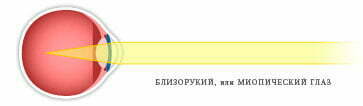
Myopia, or nearsightedness, is the most common refractive error. A person sees well up close, but distance vision is blurry. This most often happens when:
- the eyeball is too long, or
- the cornea has excessive curvature.
In this case, rays from distant objects focus in front of the retina rather than on it. As a result, the image “spreads out,” and the brain receives a picture without sharp outlines.
Hyperopia (farsightedness)
Hyperopia (farsightedness) is a condition in which near vision is more often reduced. It occurs when:
- the eyeball is too short, or
- the cornea is flatter than required for precise focus.
As a result, light rays focus behind the retina rather than on it. That is why reading, working with documents, or using a phone can cause strain, fatigue, and headaches more quickly.
Astigmatism
Astigmatism is a condition related to an uneven shape of the cornea, the lens, or the eye’s optical system as a whole. Because of this, the eye cannot form a single precise focus, and vision may be blurred both near and far.
Without correction, astigmatism often comes with:
- rapid eye fatigue,
- burning or discomfort,
- headaches,
- reduced vision quality at dusk.
Presbyopia (age-related farsightedness)
Presbyopia is an age-related focusing change: after the age of 40–50 it becomes harder to see clearly up close. People start holding text farther away and more often need reading glasses.
The most common reason is reduced elasticity of the natural lens: it changes shape less effectively, so the eye loses the ability to focus quickly and accurately on near objects.
Cataract
Contrary to a common myth, a cataract is not a “film” on the surface of the eye. It is a clouding of the lens inside the eye, which prevents light from reaching the retina properly. Over time:
- vision becomes “foggy,”
- contrast decreases,
- glare appears,
- glasses stop providing the usual improvement.
When light passes through a clouded lens, it scatters—so the image loses sharpness.
To find the cause and get a treatment plan, book an eye examination. What it includes and what it costs is on the page eye examination in Kyiv.