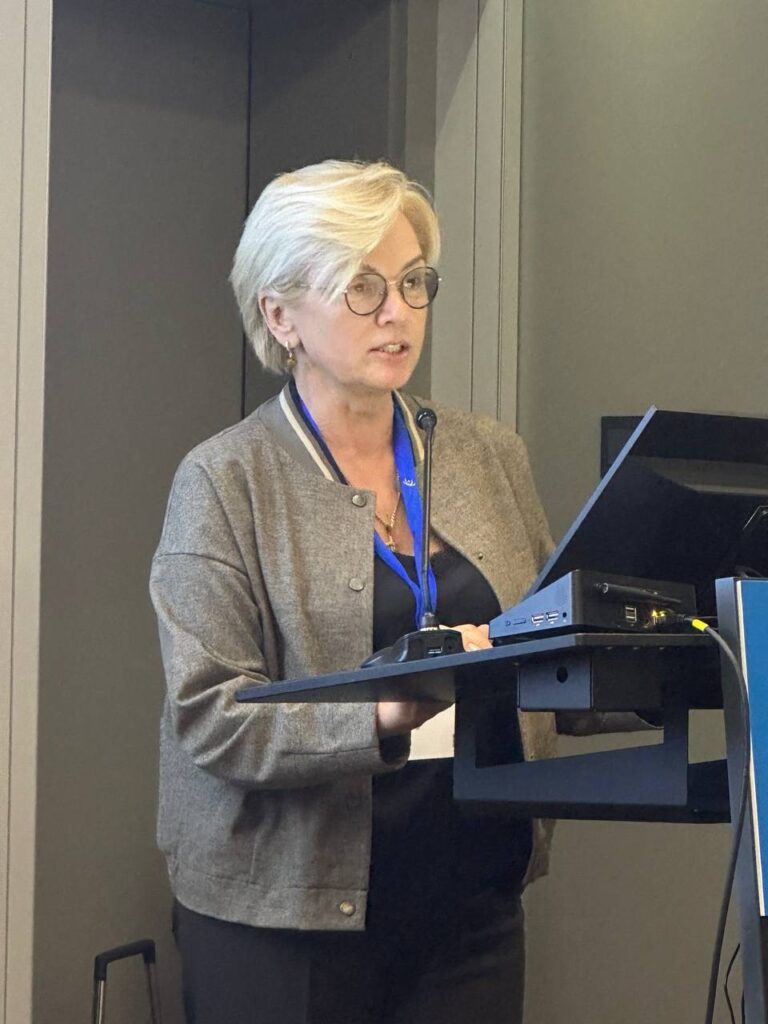
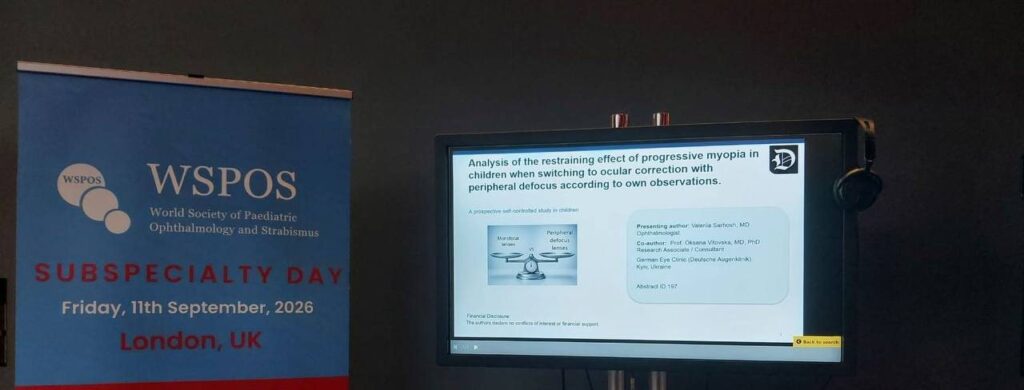
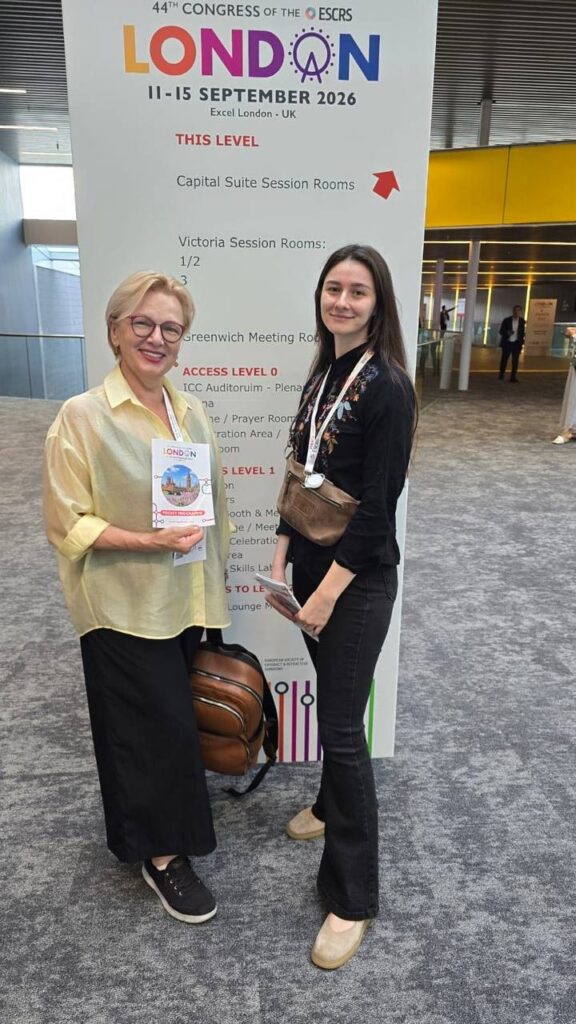
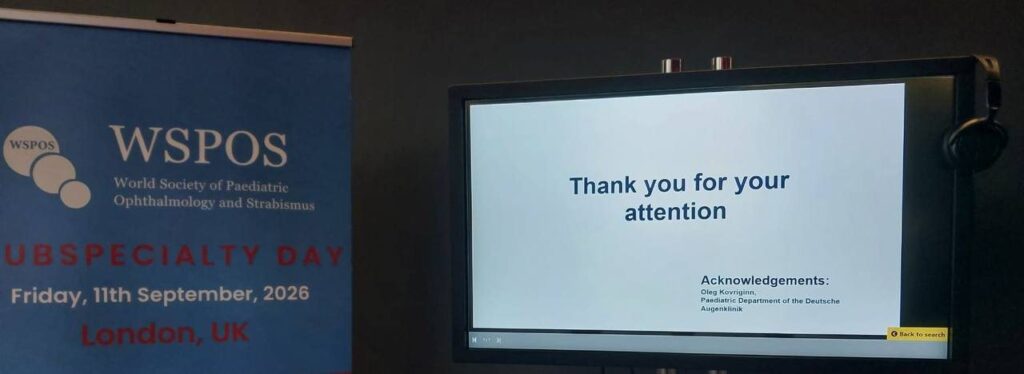
As part of the 44th ESCRS Congress in London, the one-day meeting of the World Society of Paediatric Ophthalmology and Strabismus (WSPOS) took place. Valeriia Sarhosh, a doctor at the German Eye Clinic, presented on myopia control in children — specifically on what happens when a child switches from ordinary spectacle lenses to peripheral defocus lenses.
Why myopia is one of the most pressing topics in paediatric ophthalmology
Myopia in children is not merely “a minus in glasses”. It is a condition in which the eyeball elongates faster than it should. The stronger the myopia in adulthood, the higher the risk of serious complications later: retinal detachment, myopic maculopathy, glaucoma.
That is why the modern goal is not only “for the child to see well now”, but to slow down the progression of myopia while the eye is still growing.
What peripheral defocus lenses are
Ordinary glasses give a sharp image in the centre. But at the periphery of the retina the image is often focused behind it — and for the eye this is a signal to “keep growing”.
Peripheral defocus lenses (also called myopia control lenses) work differently. The centre of the lens provides the usual correction for clear vision. Around the centre there are special micro-zones that create myopic defocus at the retinal periphery — a signal to “slow the growth down”. The child sees clearly, while the stimulus for axial elongation is reduced.
What the presentation was about
Valeriia Sarhosh’s presentation focused specifically on the switch from ordinary lenses to peripheral defocus lenses: how myopia progression changes after such a switch, what doctors and parents should watch for, and which expectations are realistic.
Importantly, the presentation was based on the clinic’s own observations — a prospective study in children assessing the restraining effect after switching to correction with peripheral defocus. The co-author of the work is Professor Oksana Vitovska. In other words, these are not second-hand data but results obtained in our own patients in Kyiv.
Key practical takeaways:
- Timing matters. The earlier myopia control starts, the fewer “extra dioptres” are accumulated.
- Follow-up is essential. Not only visual acuity is assessed, but also the change in refraction and axial length — an objective measure of whether the chosen method works.
- Wearing time is critical. These lenses only work if the child wears the glasses all the time, not just “for lessons”.
- It is not the only method. Myopia control also involves near-work habits, time outdoors in daylight and, where indicated, other approaches.
What this means for parents
If your child has been diagnosed with myopia and the “minus” increases every year, this is a reason not simply to prescribe new glasses, but to discuss a myopia control strategy with the doctor. It is important to understand: no method “cancels” myopia. The goal is for the child to reach adulthood with a lower prescription and lower risks for the retina.
Book a paediatric consultation
At the German Eye Clinic you can have a full eye examination for your child and receive an individual myopia control programme. You can book an appointment with Valeriia Sarhosh by phone or online.
How we examine and treat children's eyes is described on the page paediatric ophthalmology.