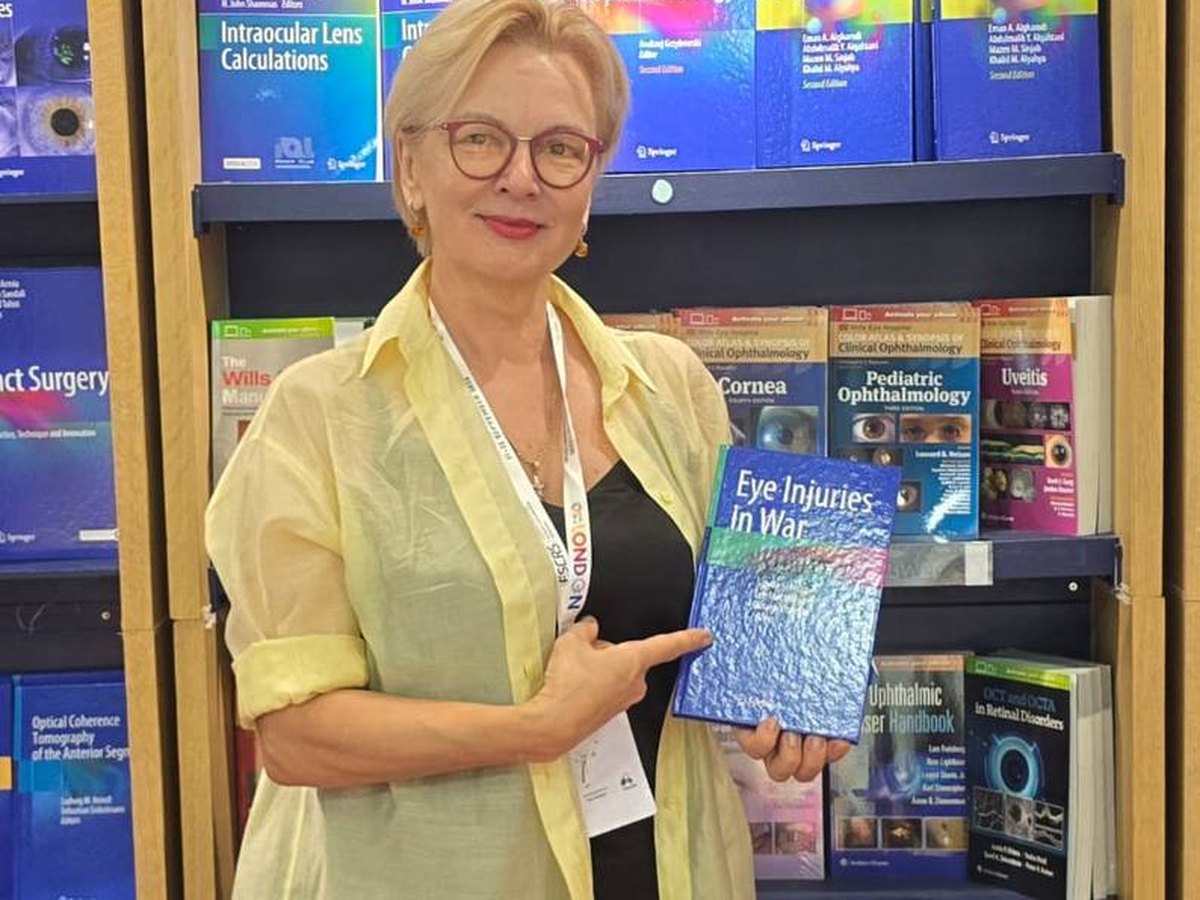
At the 44th ESCRS Congress in London, Professor Oksana Vitovska of the German Eye Clinic presented a new international book on eye injuries in war. She is an author and co-editor of the volume. It is a joint work of German and Ukrainian specialists — experience gained during the full-scale war, systematically collected in one book for the first time.

How a 90-minute workshop grew into a textbook
The story began in March 2025. Oksana Vitovska and Dr Sibylle Scholtz (Germany) organised a 90-minute session on eye trauma surgery at the Pan Ophthalmologica congress. Ukrainian ophthalmologists spoke not about polished case series, but about reality: what they had seen and done while treating combat eye injuries.
The response in the room was strong enough for the organisers to decide that one workshop was not enough. Eighteen months later that conversation had become a book published by Springer, with contributors from Germany, Ukraine and Armenia. Eye Injuries in War was edited by Sibylle Scholtz, Lee MacMorris and Oksana Vitovska. At the congress the work was presented as “Eye Injuries in War: Clinical, Surgical, and Humanitarian Perspectives”.
Why such a book is needed now
Modern warfare produces a different type of injury from the one classical ophthalmology prepares for. Eye trauma does not arrive on its own but in combination: eye, orbit, face and systemic injuries at the same time. Add to this blast injuries, intraocular foreign bodies, a high infection risk when treatment is delayed, and triage under mass-casualty conditions.
One telling detail: among the chapters is “Determination of Visual Acuity Without Optical Aids”. A standard vision test assumes a consulting room, electricity and equipment. A triage tent near the front line has none of that — yet the extent of visual damage has to be assessed immediately. That is a separate skill, and one that standard ophthalmology training usually does not cover.

What the book covers
- blast eye injuries and intraocular foreign bodies;
- assessment and triage of casualties in resource-limited conditions;
- prevention of infectious complications when treatment is delayed;
- reconstructive surgery and long-term rehabilitation;
- the history of war ophthalmology as a distinct field of medicine.
After the presentation, Professor Vitovska answered questions from colleagues from several countries.
Knowledge that must not be lost
The core idea of the book is pragmatic: knowledge generated under crisis conditions has a short shelf life if nobody writes it down.
Ukrainian clinical experience has now become part of the international professional literature. Eye Injuries in War is available from Springer.
About the author
Oksana Vitovska — MD, PhD, Professor at the Department of Ophthalmology of the Bogomolets National Medical University, Honoured Doctor of Ukraine, Chair of the Board of the All-Ukrainian Alliance of Ophthalmologists, author of more than 240 scientific publications. She sees patients at the German Eye Clinic.